Unbelievable space discoveries in 2025
Dec 31, 2025
Washington [US], December 31: 2025 will be an impressive year for astronomy, and among those discoveries will be some strange but incredibly exciting discoveries about space.
Lemon-shaped planet
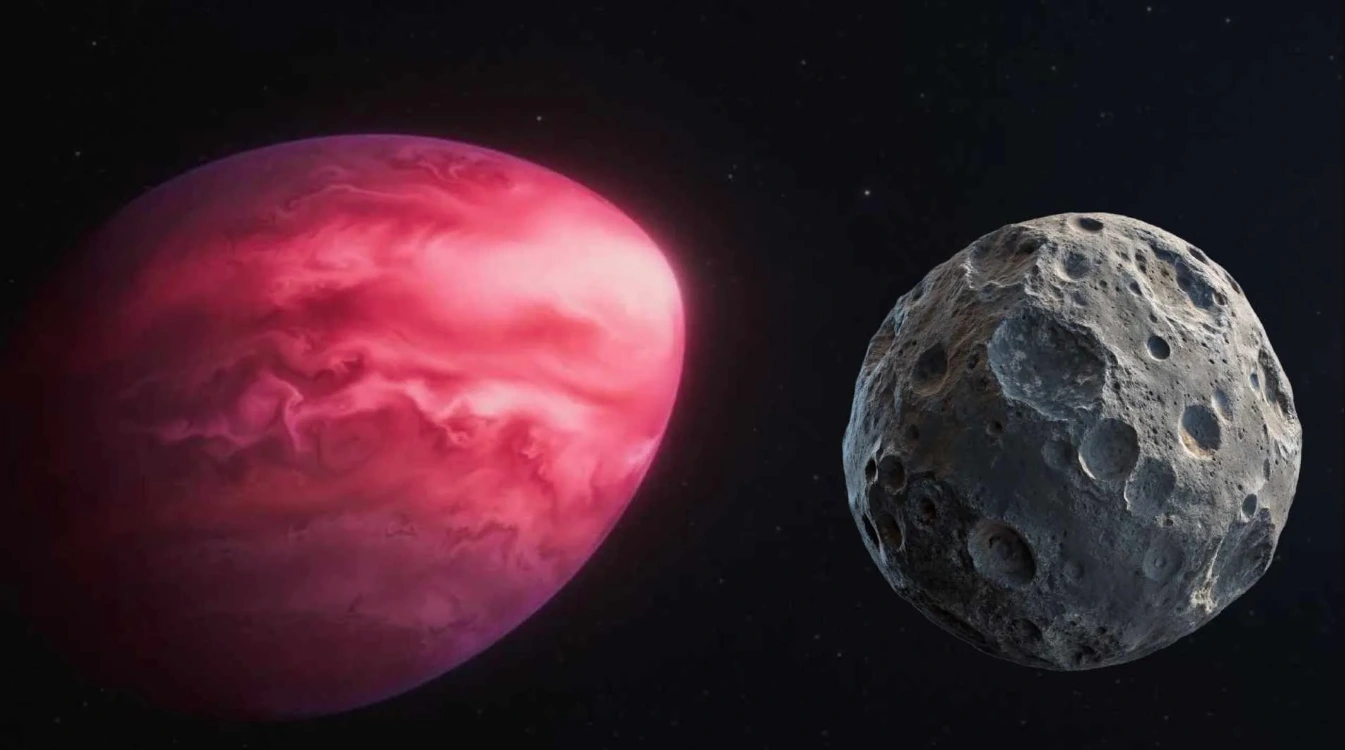
Leading the list of bizarre space discoveries in 2025 is PSR J2322-2650b, the first planet shaped like a lemon. This exoplanet has a mass comparable to Jupiter. The "lemon planet" possesses an extremely unusual atmosphere, composed primarily of helium and carbon, a characteristic never before seen in the more than 6,000 exoplanets cataloged so far.
Thanks to the James Webb telescope , astronomers believe that soot clouds may be floating in the planet's atmosphere. Furthermore, in the deeper layers of the atmosphere, carbon clouds could condense into diamonds, suggesting the prospect of scorching "diamond rains." However, the formation process of PSR J2322-2650b remains a mystery to this day.
The planet orbits an anomalous star, with a mass comparable to the sun but compressed to the size of a city. Remarkably, PSR J2322-2650b is located very close to its host star, at a distance of only about 1.6 million kilometers.
Earth's "fake" moon
The "fake" moon, named 2025 PN7, was first discovered on August 2nd thanks to the work of two researchers, Carlos and Raúl de la Fuente Marcos, from Complutense University of Madrid (Spain). With a non-perfectly circular orbit toward the sun, 2025 PN7 has an orbital period of nearly one year.
Among the many different theories attempting to explain the existence of the "fake" moon, Harvard University astrophysicist Avi Loeb has put forward a noteworthy speculation. He suggests that 2025 PN7 may have "technological origins from Earth." Based on observations and orbital calculations, Loeb believes that 2025 PN7 is likely Zond 1, the Soviet spacecraft launched in 1964 to explore Venus but which did not complete its mission.
PN7 is expected to continue "accompanying" Earth until 2038, according to the 2025 forecast.
The Unsolved Mystery of the Great Void
Discovered in 1981 by astronomer Robert Kirshner, the Bootes Void, also known as the "Great Void," is a nearly spherical region of space located near the constellation Bootes. Often referred to as a "super-void," the Great Void is one of the largest known regions of space that contains absolutely no objects.
This enormous void has a radius of approximately 330 million light-years, equivalent to 0.27% of the diameter of the observable universe. Since its discovery in 1981, along with the development of astronomical techniques and imaging, more and more data and new hypotheses have been put forward. However, instead of shedding light on it, these new discoveries have only made the Bootes Void even more mysterious.
Have dark matter finally been observed?
According to a report published in the Journal of Cosmology and Astroparticle Physics , scientists say they have made a significant breakthrough in approaching one of the long-standing mysteries of astronomy and physics: dark matter.
Tomonori Totani, an astronomer at the University of Tokyo and the lead author of the study, said his team discovered gamma-ray bursts with photon energies up to 20 gigaelectronvolts (approximately 20 billion electronvolts), spread out in a structure resembling a "halo" pointing toward the center of the Milky Way.
And the shape of this gamma-ray emitting component closely matches the predicted structure of the dark matter halo.
The largest rotating structure ever observed in the universe.
In a study led by the University of Oxford (UK), a team of researchers discovered one of the largest rotating structures in the observable universe. It is an ultrathin but expansive cosmic filament located 140 million light-years from Earth. This structure spans 50 million light-years across, with all the galaxies within it rotating in the same direction.
The fastest rotating asteroid near Earth.
The near-Earth asteroid 2025 OW safely flew past Earth on July 28th, coming within approximately 633,000 km of us. This celestial body astonished astronomers with its extremely rapid rotation speed, the fastest ever recorded for a near-Earth asteroid.
According to observers, 2025 OW takes only about 1.5 to 3 minutes to complete one rotation around its axis, a dizzying speed never before seen, challenging current understanding of the structure and stability of asteroids.
Witnessing the birth of an asteroid for the first time.
In July, researchers captured the first images of a new star system forming around a young star called HOPS-315, located about 1,300 light-years from Earth.
This discovery was made possible through a collaboration between the James Webb Space Telescope and the ALMA telescope located in Chile.
Comet turns "gold"
First discovered in May, a comet named C/2025 K1 originating from the Oort cloud illuminated the sky with its characteristic yellow hue after passing closest to the sun in October.
Initially, astronomers did not expect C/2025 K1 to survive its closest approach to the sun, as the intense heat and radiation from the central star often cause many comets to disintegrate on their first pass.
However, C/2025 K1 managed to behave beyond expectations and actually survived the ordeal, becoming one of the most impressive astronomical phenomena of the year.
Source: Thanh Nien Newspaper