From Ports to Tech Cities: Lexora Realty Holdings Maps India's Next Real Estate Growth Belt
Jan 29, 2026
PRNewswire
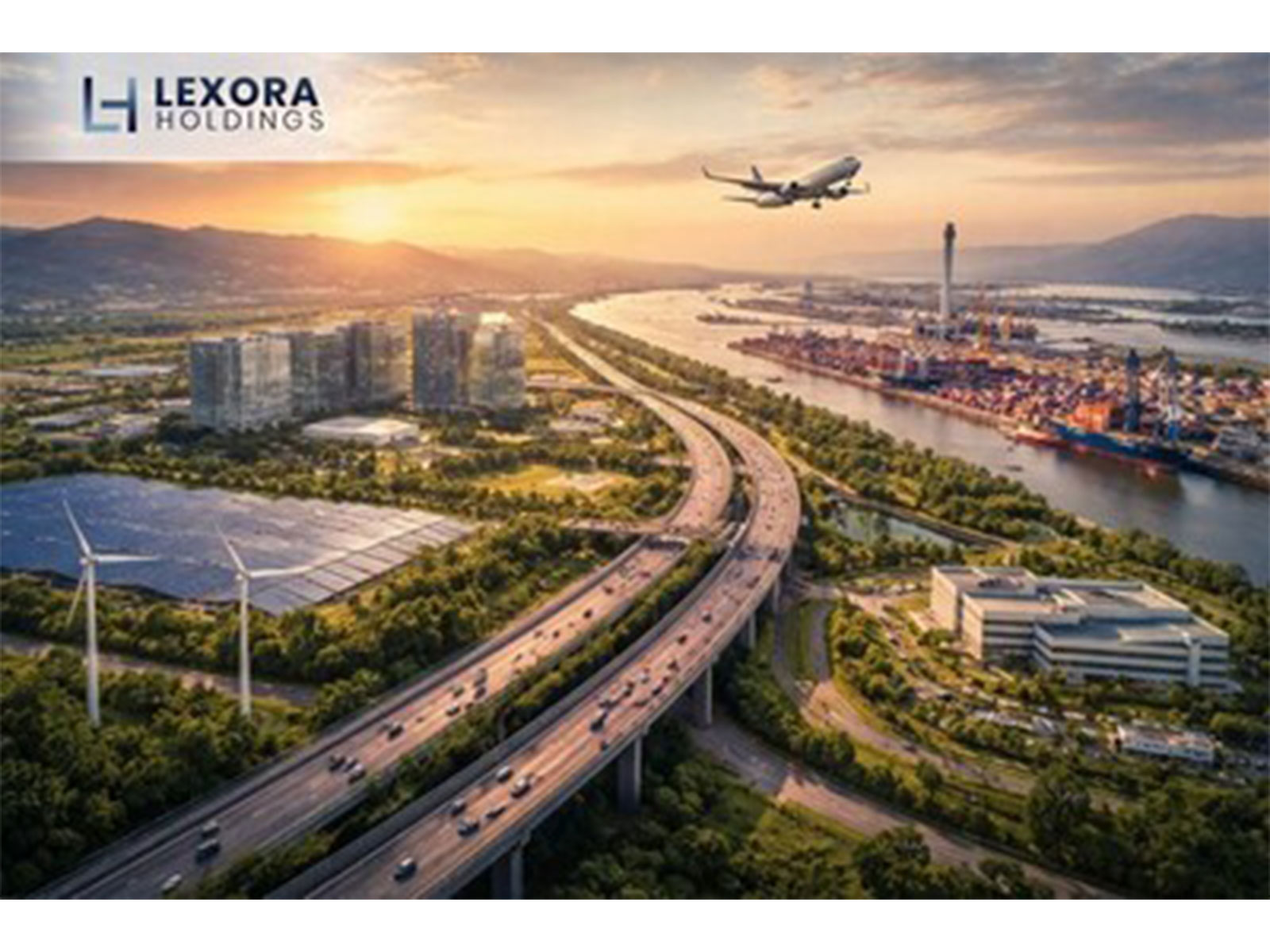
Bengaluru (Karnataka) [India], January 29: India's real estate sector is going through a noticeable shift. As investments increase in ports, airports, technology parks, data centres and renewable energy, growth is no longer limited to traditional city centres. Instead, it is gradually moving toward regions shaped by infrastructure, employment and long-term planning.
Industry watchers point out that the next phase of real estate growth will be driven less by speculative expansion and more by areas where logistics, aviation, technology and clean energy come together. These infrastructure-led corridors are increasingly being seen as the backbone of India's future urban and industrial development.
In this changing landscape, Lexora Realty Holdings Pvt Ltd has outlined its Vision 2030 roadmap, aimed at building a diversified real estate portfolio across some of India's most promising infrastructure-driven regions. The company has set a development target of approximately ₹300 crore in assets by 2030, aligned with long-term economic and infrastructure priorities.
Mapping India's Emerging Growth Corridors
Around Bengaluru, the Aero City corridor near Kempegowda International Airport is steadily emerging as an important aviation-linked business and residential zone. With global aerospace and defence companies such as Airbus, Boeing, Dassault Aviation, Safran and GE Aviation establishing operations, the region is expected to see significant job creation in the coming years.
This growth is already driving demand for office spaces, employee housing, hotels, healthcare facilities, retail and educational infrastructure. Planned road and metro connectivity, along with Karnataka's KWIN City initiative, are further supporting the region's development. Airport-led zones, urban planners note, often grow into long-term economic centres rather than short-lived real estate cycles.
On the western coast, Kerala's Vizhinjam Deep Sea Port corridor is emerging as a key logistics and transshipment hub. Located close to major international shipping routes and supported by natural deep-water depth, the port has begun handling large container vessels. Historically, ports of this nature have played a major role in regional transformation, as seen in global trade centres such as Dubai and Singapore.
As Vizhinjam expands its operations, surrounding areas across the Nagercoil-Thiruvananthapuram-Kochin belt are expected to see growth in logistics parks, warehousing, allied industries, tourism and residential development.
In eastern India, Visakhapatnam's AI City region in Andhra Pradesh is taking shape as a technology and data infrastructure hub. With global technology companies such as Google involved in early development and further data centre investments expected, demand is likely to rise for commercial real estate, quality housing and urban services for a skilled workforce. Data centres, which are increasingly treated as long-term real estate assets globally, are expected to influence development across this corridor.
Similarly, Hyderabad's proposed Future City corridor represents a planned expansion focused on innovation, research and global business infrastructure. Such master-planned developments are widely viewed as more sustainable over the long term compared to unplanned urban sprawl.
Beyond major cities, parts of the Karnataka-Andhra Pradesh border region are gaining attention due to renewable energy investments. Large-scale solar and agri-voltaic projects, where solar power generation is combined with agricultural activity, are being developed in these areas. Such models, already implemented at scale in countries like China, are expected to support long-term land value creation, employment generation and India's emerging carbon credit ecosystem.
Vision 2030: Infrastructure-Aligned Growth
As real estate strategies increasingly shift toward infrastructure-linked development, Lexora's Vision 2030 plan focuses on building assets that remain relevant across economic cycles rather than responding to short-term market trends.
As part of its ₹300 crore Vision 2030 roadmap, Lexora Realty Holdings plans to develop a mix of infrastructure-aligned assets. These include a 10 MW solar power plant integrated with an agri-voltaic farm in the Karnataka-Andhra Pradesh border region, a 75+ acre logistics park near the Vizhinjam Deep Sea Port, Housing and office spaces near Bengaluru's Aero City corridor, Visakhapatnam's AI City and Hyderabad's Future City corridor.
According to Leadership team of Lexora Realty Holdings, long-term real estate growth will be closely tied to economic relevance.
"The coming decade will favour regions where infrastructure, employment and global connectivity come together. Ports, airports, technology hubs and clean-energy zones are shaping how cities grow. Vision 2030 is built around identifying such regions early and developing assets that match how India will live, work, trade and generate power," said Raheesh A, Co-founder of Lexora Realty Holdings Pvt Ltd.
Lexora's approach centres on strategic land acquisition, diversification across asset categories and strong focus on due diligence and documentation, supported by regionally focused execution teams.
Leadership team of Lexora Realty Holdings, highlighted the importance of discipline and planning in emerging corridors.
As per them, Indian real estate is gradually moving away from congested city cores toward better-planned infrastructure corridors. The emphasis must be on clean titles, sustainable development and execution capability. Assets created in these regions should stay relevant for decades, not just through one market cycle.
Relevance for Fractional Real Estate Platforms
Market observers note that infrastructure-driven corridors also create opportunities for fractional real estate investment platforms, allowing smaller investors to participate in larger assets such as logistics parks, commercial offices and data-centre-linked developments. When focused on economically active regions, such investments tend to offer more stable demand and balanced long-term value creation.
Backed by Established Group Experience
Lexora Realty Holdings Pvt Ltd is owned by an Indian business group with over Ten years of operating experience. Lexora Holdings is headquartered in Bengaluru, Karnataka and has an operational presence across North East India, Kerala and Dubai, with businesses spanning real estate, technology platforms, EdTech and HR services.
Building Along India's Next Growth Belt
As India continues to strengthen its position in global manufacturing, technology and trade, real estate is increasingly seen as a supporting pillar rather than a standalone sector. The next phase of growth, experts suggest, will be shaped along corridors that connect ports, airports and technology centres, where infrastructure and economic activity reinforce each other.
Through its Vision 2030 roadmap, Lexora Realty Holdings aims to be a long-term participant in this shift, focusing on regions where India's future growth is already taking shape.
Photo: https://mma.prnewswire.com/media/2872386/Lexora_Realty_Holdings.jpg
(ADVERTORIAL DISCLAIMER: The above press release has been provided by PRNewswire. ANI will not be responsible in any way for the content of the same)